
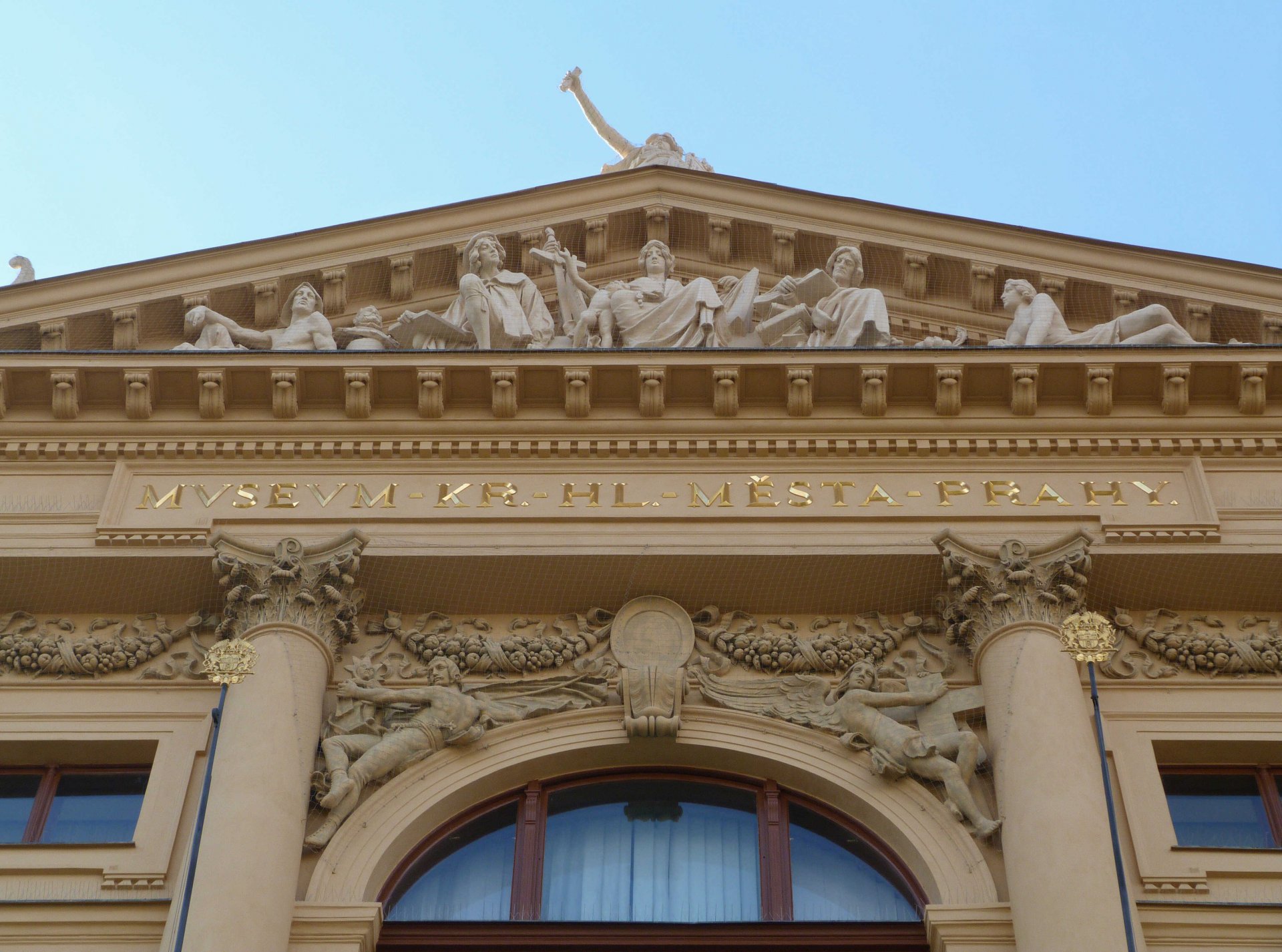
The Main Building of the Museum of Prague
Museum within the City Walls
Part of the city walls, northeast of the Poříčská Gate, there once was Saint Christopher's Bastion. As the original walls lost their significance and began to disappear, a small café pavilion was built here, where café owner E. Ponec opened his business in 1876. However, his business was not successful, so at the end of 1882 the city council entrusted the building to the Prague City Museum (founded on 3 October 1881). Two years later, the museum opened its first exhibition here. Yet the building was still far from its current impressive size. Between 1896 and 1898 an "extension" was built, which is today's main exhibition building. However, even that was insufficient for the museum's needs. The original building, which housed the unsuccessful café, was demolished in 1974 due to the construction of the North-South Motorway.
The building's facade is decorated with symbolic ornaments by Ladislav Šaloun, the author of Jan Hus Monument in the Old Town Square.
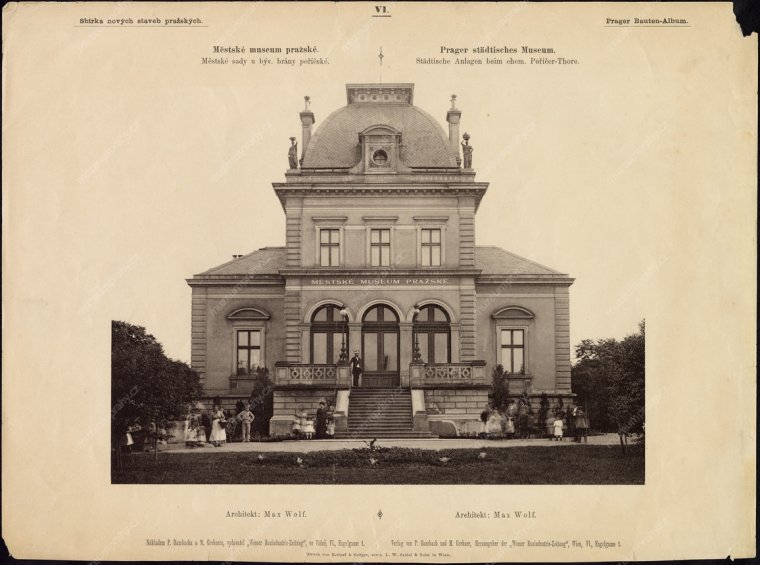
The Café Pavilion was built in 1876 on the site of the original St. Christopher Bastion. The museum acquired it in 1882. (Artefact code MMP H 99 909)
New era – New Building
Prague was growing rapidly at the end of the 19th century, and the forward-thinking city council wanted a space that would not only accommodate the ever-expanding collections but, above all, would represent the history of Prague with dignity. The council therefore organized an architectural competition, which was won by architect Antonín Balšánek (together with Josef Schulz). The construction itself was completed relatively quickly between 1896 and 1898, and the museum opened to the curious public in 1900.
When the new building was constructed, original architectural fragments from houses demolished during Prague's redevelopment at the turn of the 20th century were incorporated into its walls. Today, you can still see coats of arms, portals, tombstones, house signs and other surviving architectural elements embedded directly in the museum's walls, offering a glimpse of old Prague that no longer exists.
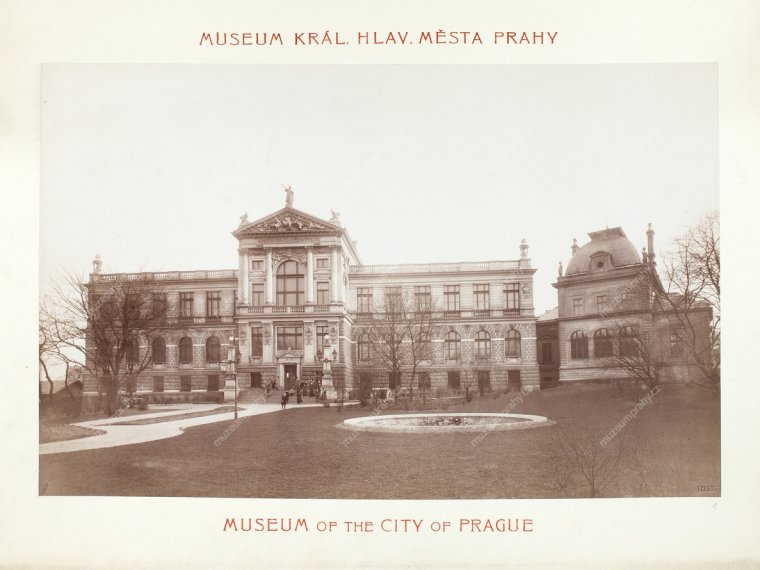
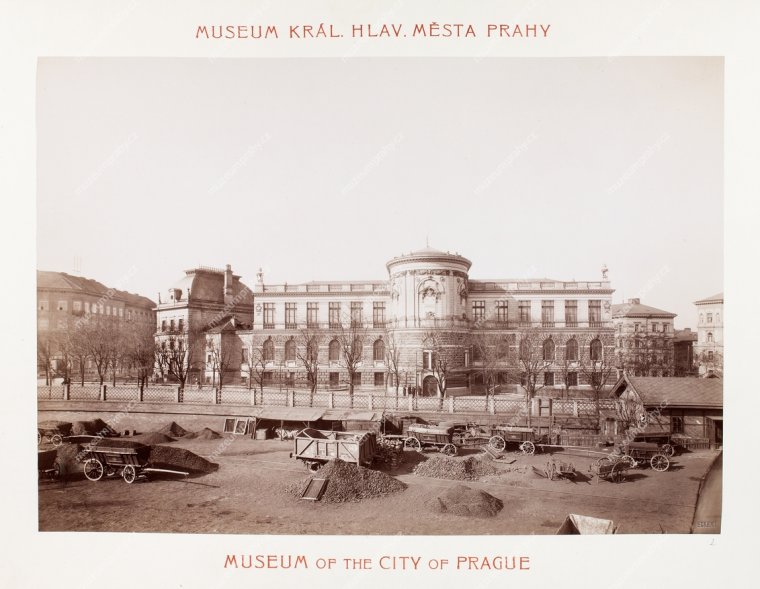
Between 1896 and 1898, the current Neo-Renaissance building designed by architect Antonín Balšánek was added to the Café Pavilion. (Artefact code MMP H 13 874/1-2)
A Modern European Museum
Between 2020 and 2025, the building underwent extensive renovation. However, it was not merely a building being renovated; a genuine cultural monument was being restored, so the work was carried out under the supervision of heritage conservationists. In fact, this was the first major renovation in over 120 years of the building's existence!
Before the renovation began, the building had to be cleared. Hundreds of collection items, archaeological finds, and works of art were moved to temporary storage facilities.
The Museum of Prague offers a different kind of museum experience
The renovation included the restoration of interiors, modernization of technical facilities, and the addition of wheelchair access. But it didn't stop at renovation and restoration. The Museum of Prague was designed to be a modern museum that uses large-format projections, interactive installations, and even AI. In 2025, this modern European museum opened its doors to visitors in a stunning Neo-Renaissance building, seamlessly blending the city's history with the most cutting-edge approaches to contemporary museology.