
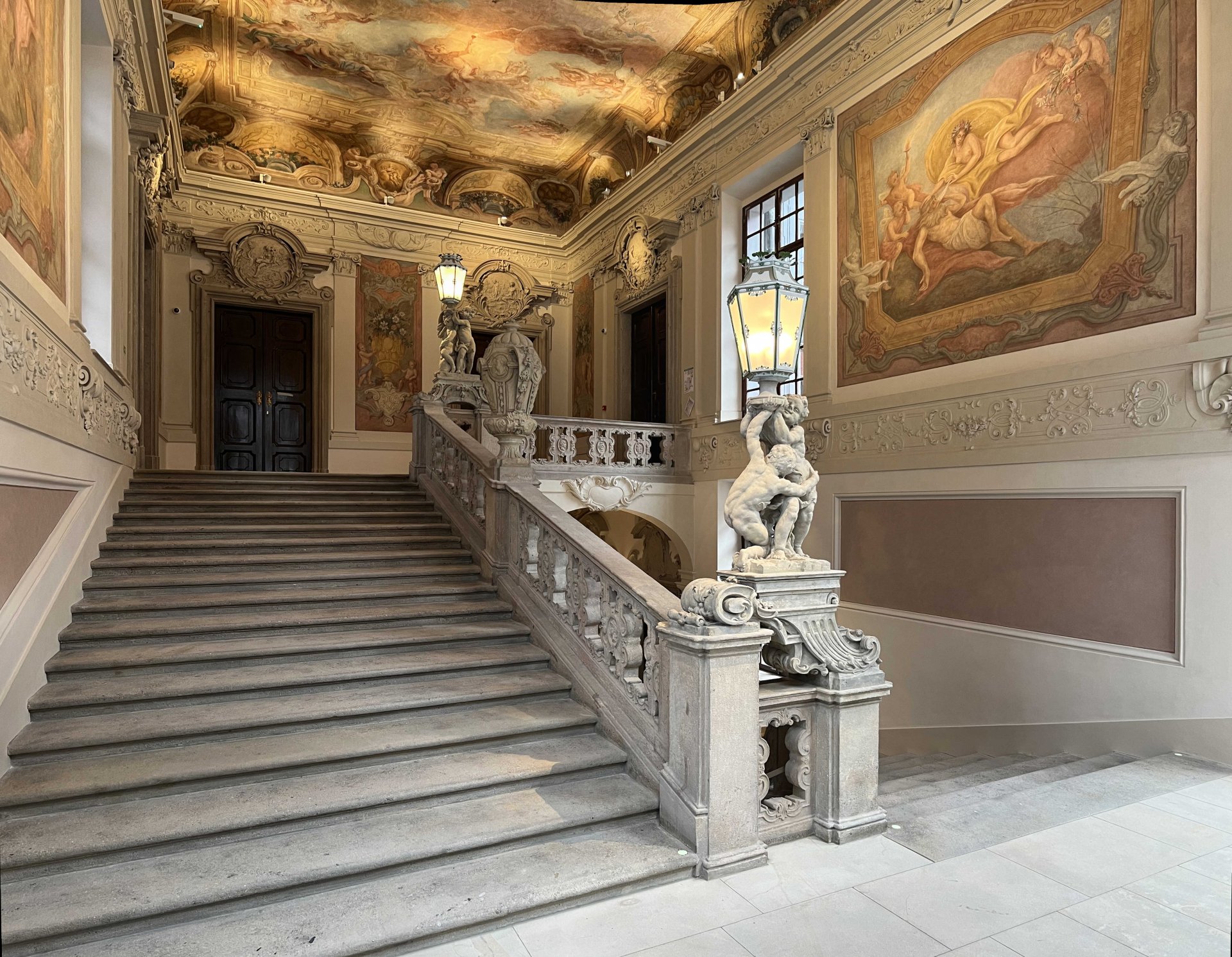
Clam-Gallas Palace
An Impressive Mansion in the Heart of the City
The first townhouse used to stand on the site of today's palace as early as 1351. Over the following century, the house was owned by prominent townspeople and aristocrats. The family of the goldsmith Otlín and Jiří Samuel of Hrádek used to live here. Since 1604 the house had been owned by the Kinsky family, who had it rebuilt into a Renaissance palace. In 1634 Emperor Ferdinand II donated the palace to General Count Matyáš Gallas for his loyal service. His grandson Jan Václav decided to transform the palace into a magnificent residence. He purchased the surrounding houses and commissioned the Viennese architect Johann Bernhard Fischer von Erlach to design the new stately residence. The result was one of the most beautiful Baroque palaces in the heart of Europe, which we still admire today.
In the 14th century, there used to be a house on the site of the southern part of the palace, which was rebuilt in 1351 for John Henry, the Margrave of Moravia, the younger brother of Charles IV.
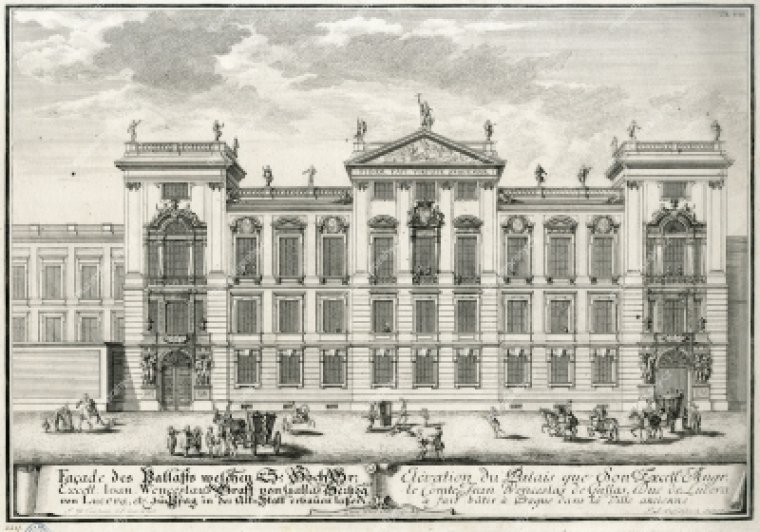
Johann Bernhard Fischer von Erlach also designed the interiors of the palace. The sculptural decoration of the exterior and the main staircase was created by Matthias Bernard Braun (or his workshop). The murals in the main staircase and several representative halls were painted by the renowned Italian painter Carlo Innocenzo Carlone. The heirs of Jan Václav Gallas gradually completed the interior decoration, including the establishment of a theater.
In the late 1790s, Ludwig van Beethoven performed here, and perhaps even earlier so did Wolfgang Amadeus Mozart and the soprano Josefína Dušková.
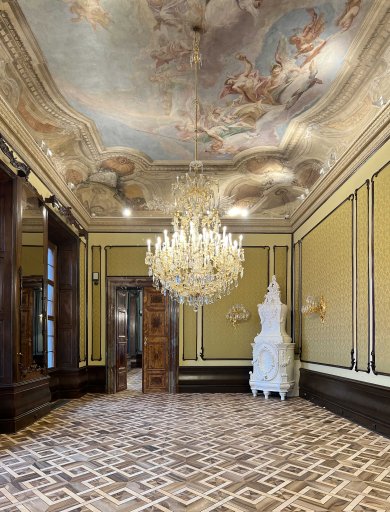
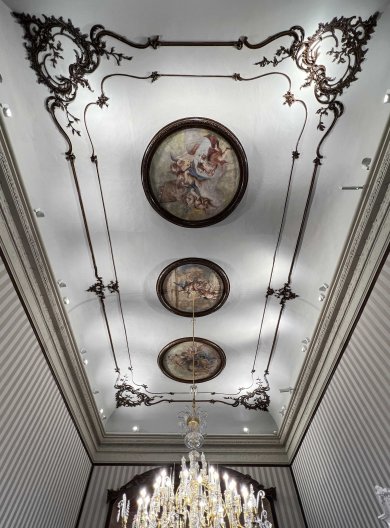
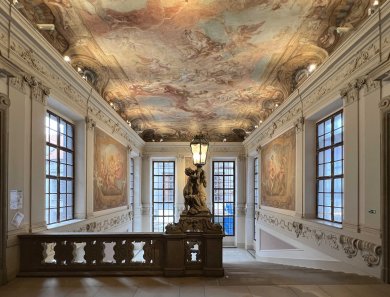
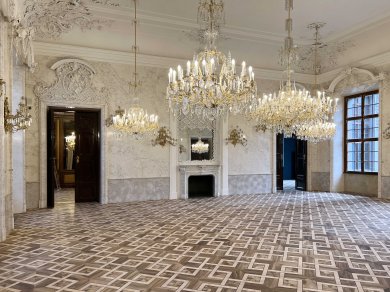
In 1800 a nearby plot of land that had once been a cemetery was purchased. This expanded the grounds to include a corner garden and a boundary wall along Mariánské náměstí. In 1812 a public fountain featuring a statue of a girl named Terezka, created by sculptor Václav Prachner, was also added. A winter garden was built in the palace's north wing. The interiors on the first floor were renovated in the Classicist style, while the representative rooms on the second floor were renovated in the Biedermeier style and later in the Second Rococo style.
The representative premises are located on the 2nd floor so that more natural light can reach them above the surrounding buildings. It's not a very common solution, but a very practical one.
From the late 19th century, the palace was rented out. The count's family lived in Vienna and kept only a small apartment in the palace for their own use. In late 1918 the palace became the seat of the Czechoslovak Ministry of Finance. After the palace was confiscated in 1945 under the Beneš Decrees, the Prague City Archives were moved here from the burned-out Old Town Hall, where they were located until 2017.
The palace underwent basic renovation work between 1978 and 1994. Major renovations followed between 2017 and 2022, during which the interiors—including the frescoes and stucco decorations—were restored. The palace was equipped with new, modern facilities and adapted for public use and for hosting cultural events.
In the prestigious Building of the Year Competition, both the public and the expert jury praised the palace's renovation: The palace was awarded Building of the Year 2022.